The Light In Phnom Penh

Words and Photos by Sam Naiman

From the Forgotten Kingdoms Blog:

The Light In Phnom Penh

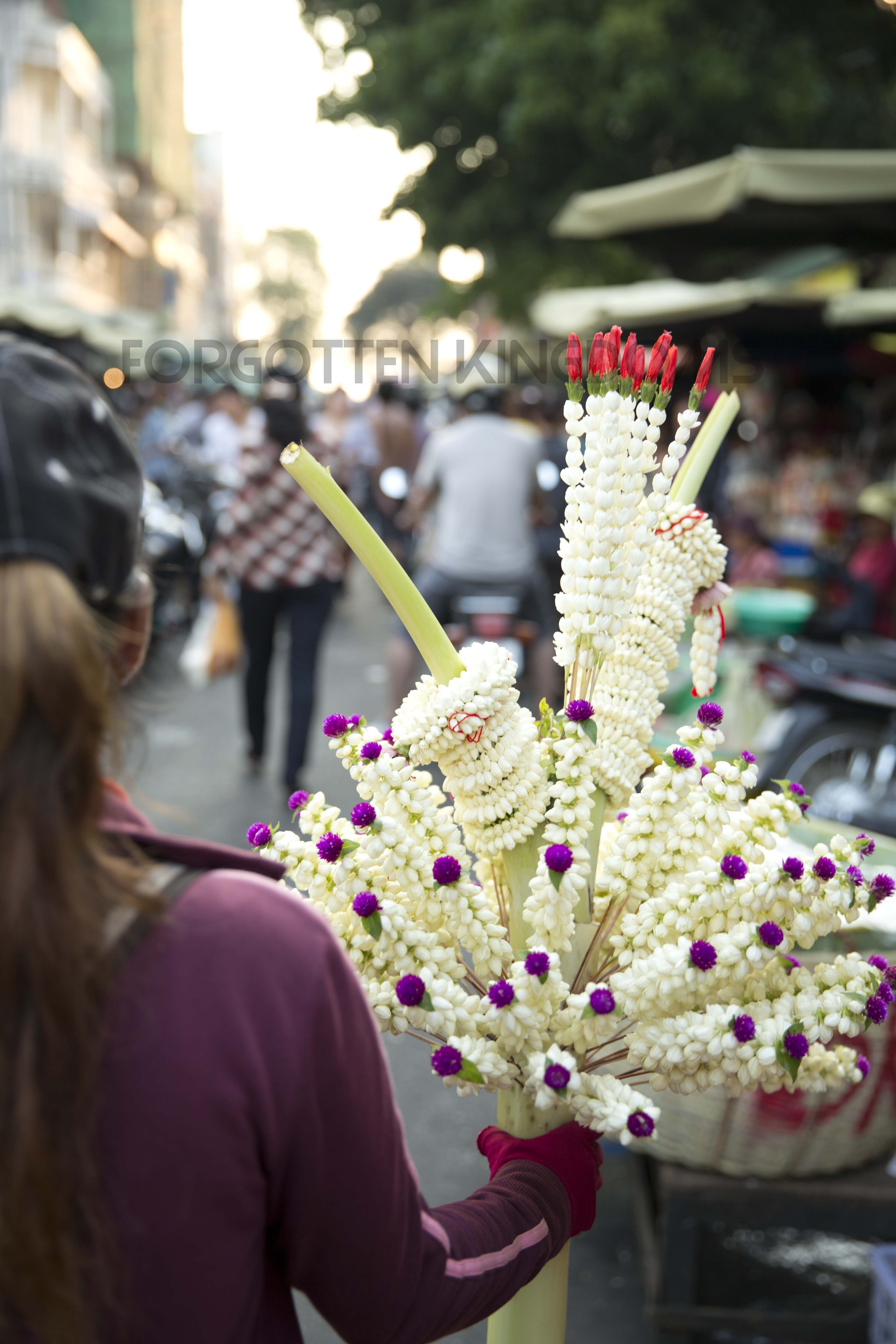
I’m here during the hot season and the equatorial sun can get to 115 Fahrenheit at mid day.  We are shooting for close to a month, each day the sun tracing a clean searing arc over the enormous buzzing sprawl of Phnom Penh, where the nature of the light is as much a construct of the city culture as it is a condition of it’s place on the planet.  The overcrowded roadways spew massive clouds of government subsidized-diesel smog into the sky, giving sunlight a warm, dreamy feel. Even when the sky is bluest here, its also a bruised grey, and shadows imbue a slight smear anywhere they are cast.

During the day, my camera constantly wears multiple Neutral Density filters combined with a polarizer, searching out tufted, gold-lined clouds and that extra tick of cerulean. These skies are consistently a tenth of a stop away from photographic catastrophe.
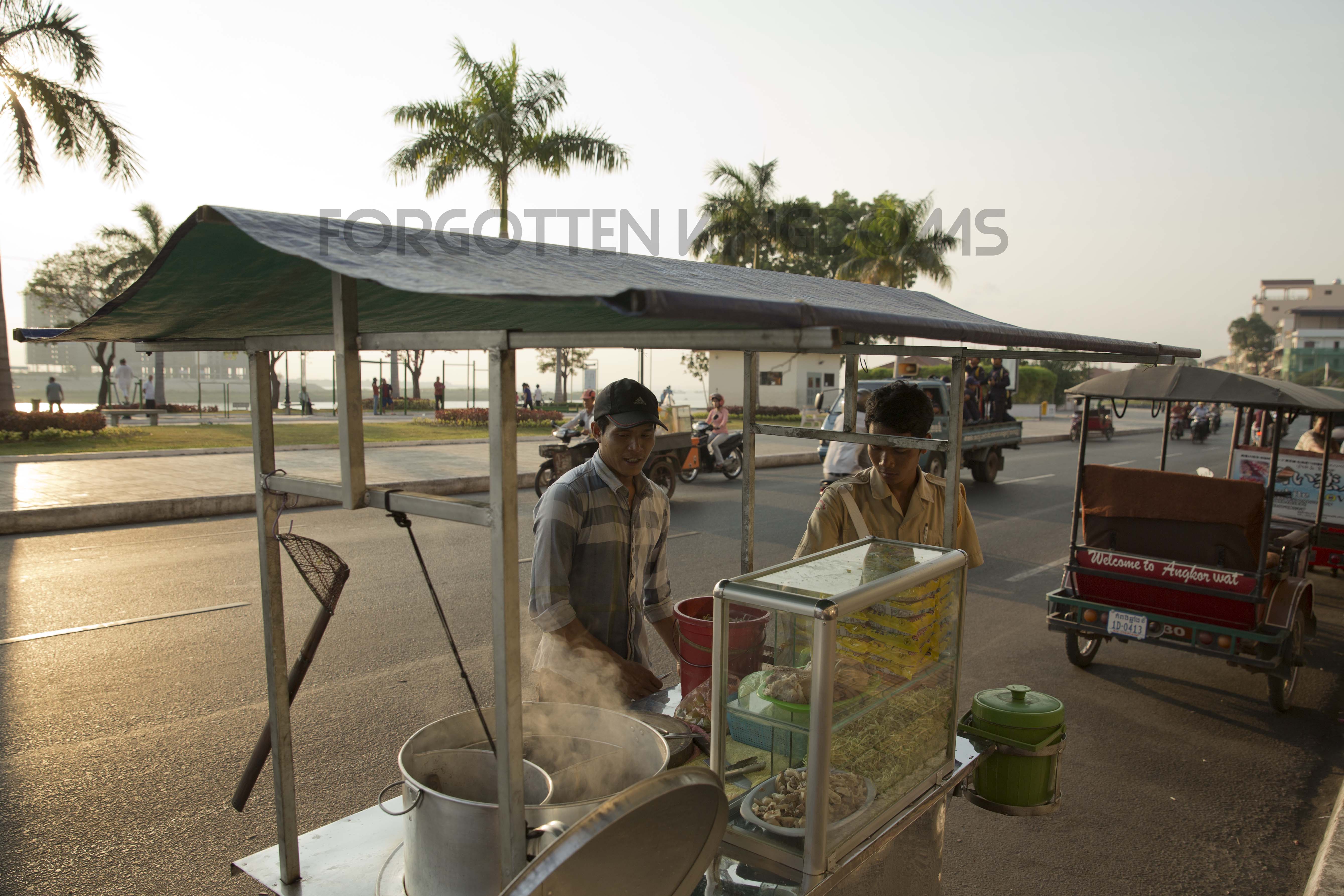
Street Vendor

In the streets, food is cooked over charcoal, making layers of iridescent haze everywhere. The crush and chaos of traffic- the windows, the overdressed chrome decals, and the mirrors of a million tuk-tuks shoot constantly moving points of light across every surface, through shadows and beam into the smoke.

At night, the fires persist. Flame is an intimate source of light as well as bare fluorescent tubes colored much bluer than the standard day-lighting hue. Depending on the level of commerce going on, these can be strung in clusters all-over, or as little as a few to a block. The traffic is just as frequent and chaotic, headlight beams roaming every surface. With street lights committed to main boulevards, images can very quickly drop off into an abyss of black, the movement of the city life hinted at in small, scattered glimpses.
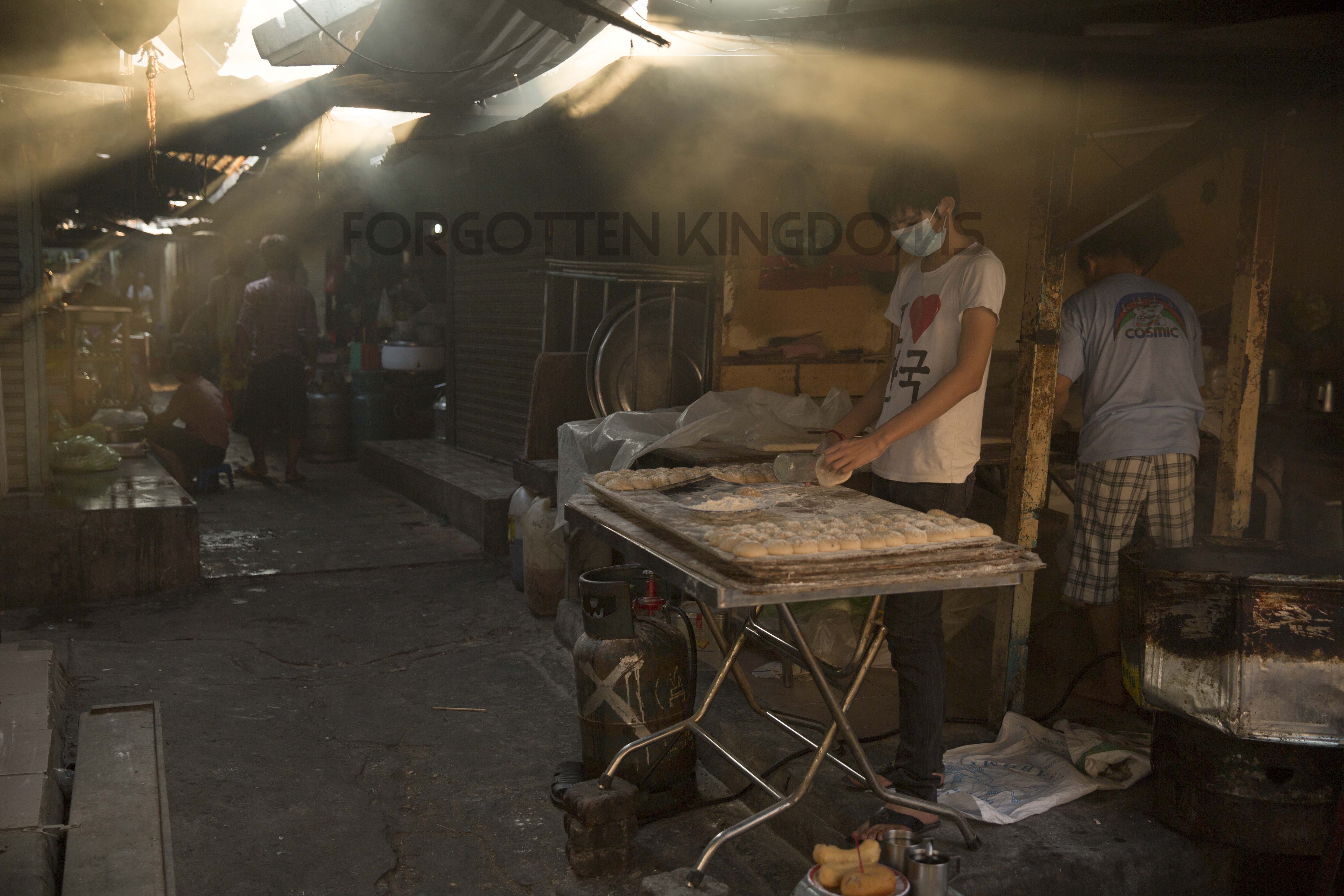
Fire Light

The sunrises and sunsets wrap everything in electric pink.  The city exhales to a slightly cooler evening reprieve, or the shared potential of a new day with a catalyzing energy that seems to emanate directly from the low sun.

The light in Phnom Penh is constantly and deeply changing. Completely immersive like the city itself, created immediately at any given moment by a people hurtling by, a life balanced deftly on a razor-thin line between past and future.
Phnom Penh Hustle

Listen, This Guy is a Knight, Part 2

Sir Ridley Scott directed the film that made me want to make films. It started as a low-budget space monster movie, a throwback to the dubious 1950’s, and ended up being fresh and scrappy, yet so masterful that it completely redefined the genre.  What is it that takes a script to such transcendent heights?  Scott has been known to drop gems from time to time.  Any department can appreciate his technique of storyboarding to be an element that can save production time and a bundle of money.  As a cameraman, right away I appreciate his technique being focused on “the performance of light on objects”. Even superficially, this simple contrast and framing cue instantly informs my lighting and camera placement.  Listening to him here, I get the feeling he’s giving up some of those insights that have allowed him to elevate his art above many other directors.  Speak it Ridley:

Listen, This Guy is a Knight, Part 1

One of the reasons I love my job so much is the people I work with.  In some circles, it’s common practice for crew, to think of actors as non-entities to be put on a pedestal.  Let them do their thing to get their performance the way it needs to be, but take a breath and remember it’s not radio.  An extremely tight working relationship between the actor and the lens has to exist to make the performance work.  Sir Michael Caine knows this, and we all ought to consider ourselves extremely lucky he’s willing to pass down what’s taken him a lifetime to learn:

“Wake Up”, part one.

A music video I recently shot for neo-soul artist Lilla D’mone was an exercise in conceptual simplicity.  The song “Wake Up” appeals a call for worldwide social awareness and solidarity. The scope is wide and fairly timeless, so we felt it necessary that the photography of the music video showcase the song by being complementary but understated.

On the shoot day, there were only 3 setups, two of them portraits of of the artists expressing images of Lilla in slightly skewed realities.  The third was to be a truer image of the artist, equal parts combination of the first two characters, but also possessing greater depth.

Visually, the differences between the Lilla personalities, and their ultimate unification were achieved through lighting, lens choice, filtration, wardrobe and makeup.  Special thanks go to makeup artist Terri Lodge for her lightning fast, beautiful work, and Koerner Camera for letting me test a few dozen optical filters in the days leading up to this shoot.

The song starts out with the words “I don’t know if i’m dreaming”, and I felt this sentiment could be expressed through the selective-focus wedge particular to a lensbaby “composer” lens.  At a 5.6 aperture, the corners are fuzzed out while Lilla sits against a blackout background, imparting a slightly disorienting, dreamlike feeling, at the same time speaking to the distress of the rock-bottom plight of the first “alternate Lilla” character the audience will see.  I used a tiffen Enhancing filter to offset the skin tones and blue highlights in the scene, and create a rich color contrast.

Next, the video transitions to another character, almost a polar opposite.  Gaffer Mike Ferry, and key grip John Petrina built a light box around the character we came to call “the diva”, using kino flos through bleached muslin to approximate cover-girl style lighting combined with a 105mm nikkor lens and Tiffen Soft FX 2 filter.

The third Lilla is also lit softly, but retains a bit of classier edge light and some shape to her facial structure.  In order to show the tumult of the world expressed in “Wake Up”, and bring each of Lilla’s realities together, we projected images of the alternate characters, and worldwide protests and tragedies onto, and around the third Lilla.  The intent of the resulting visual elements was to underscore the lyrics and delicately deepen the feeling of the song, and I think we pulled this off pretty nicely.

The music video for Lilla D’mone’s “Wake Up” will be released in early May.

Camera:  Canon 5d Mk.II

Lenses: Lensbaby 50mm Composer

Nikkor 50mm, and 105mm

Shot in H.264, posted and mastered in ProRes 422

Icarus the Owl – The Extortionist

Icarus The Owl
The Extortionist
The Spotless Mind
Dir. Rose Ayers

This music video was produced by the Jabberwocky collective in Portland, Oregon.
jabberwockyproductions.com

Crew:
Cinematographer: Sam Naiman
B Camera/Steadicam Operator: Mike Ferry
C Camera Operator: Cassie Cohn

Executive Producer: Tanner Russel

Special thanks to:
Jon Beanlands
Gearhead Grip & Electric
The Northwest Film Center
Davis Street Tavern
The Portland City Grill

Cast:
Businessman: Michael Gaddi
Extortionist 1: Aydika James
Extortionist 2: Robby French
Waitress: Amy Knight

DEVOTION Trailer

I shot this short film for first time director Martha Early in late summer, 2009.  It stars Alicia Rose and Rosalie Lowe. TAGLINE: After a nasty breakup, a young woman must choose between companionship and sanity when her new confidant exhibits sinister tendencies.

Sinister indeed. In conceptualizing the look of the short, Martha and I wanted to progressively reflect the relationship’s descent into darkness through camera work and lighting- a process I will cover more deeply in subsequent posts.  At this time, I’d like to share a few insights I have about the trailer itself.  Fair warning: its about to get both technical and philosophical up in here.

“The negative is the equivalent of the composer’s score, and the print the performance.”
-Ansel Adams

I color corrected this trailer in Apple Color, after Martha edited in ProRes 422 HQ 1080p24.  Using ProRes ensured the footage stayed a little bit pliable, which for me was more important for the trailer than the actual film.  When shooting a scene for a film, I maintain consistent light levels from shot-to-shot so that all coverage can be consistent.  Color correction is usually about small tweaks in skin tone values in different shots- a natural extension of the photography that allows a scene to cohere, assuring a viewer’s attention to the performance.  When the photography works, color correction can make a great contribution on a subconscious level.

A trailer ends up an amalgamation of shots broken away from scenes, edited together more for representative value than any other trait.  Just like an individual scene, there is a thread to each trailer that must hold together.  The stakes aren’t just that the performance might not get across, but that the viewer will pass up the film entirely.  With this in mind, it was important to color correct the trailer as if it were a scene itself.  The challenge being shots pulled from scenes that are entrenched in different lighting moods with very different skin tones and color temperatures.  This is where ProRes came in handy in this situation, allowing me to give some of the footage a tug and a nudge without sacrificing quality.  The photography in this film was largely about the actress’ facial expressions telling the story, and for that to be preserved through the trailer so naturally made me very happy.